
A nurse shift report template is often searched for when a team wants a clearer change-of-shift handover. It serves a different purpose from a nurse shift planner or personal calendar. Clinical handover transfers information needed for continuity of care through an employer-approved process; personal planning helps a worker remember duty times, travel, and recovery opportunities. Mixing the two can create omissions or expose patient information in a tool that was never designed to protect it. Research reviews of structured handover approaches, including ISBAR, suggest that structure can help organize communication, but studies vary in setting and certainty. No online template can replace local policy, professional judgment, or an approved clinical record.
First identify which job the template must do
Before downloading or designing a form, define its audience and purpose. A clinical report may be used by licensed staff to communicate patient-care information, risks, pending tasks, and escalation needs. The required fields depend on the unit, patient population, employer rules, and applicable law. A personal shift tracker has another audience: the worker. It may contain a date, start and end times, duty type, location label, roster status, commute estimate, and private reminders. It should not contain patient names, diagnoses, room numbers, clinical notes, or other identifying details. If you need a clinical report, ask your facility for its current approved format and training materials.
What structured-handover research says
A 2024 systematic review of ISBAR implementation in nursing reports describes the framework as a way to organize a handover around identification, situation, background, assessment, and recommendation. The review synthesizes studies across different environments, so its findings should be interpreted in context rather than as proof that one exact form works everywhere. A later systematic review of structured nurse shift handover likewise reports a varied evidence base, with differences in methods and outcomes. Structure may support consistency, but a checklist alone cannot guarantee accurate communication: staff need training, an appropriate environment, an opportunity to ask questions, and local procedures for urgent information. These studies evaluate clinical communication interventions; they do not validate a consumer scheduling app as a handover system.
A personal shift schedule template that stays useful
For personal planning, start with a small set of fields: shift date; start and end time; whether the duty crosses midnight; shift label; confirmation status; commute or preparation buffer; and a note about a roster change. Include time zone only if you coordinate across locations or import a calendar feed. Mark provisional shifts clearly and update from the employer's authoritative roster when changes are confirmed. If an overnight duty ends the next morning, represent the end date explicitly so the shift is not accidentally displayed as a short same-day block. Keep reminders neutral—“shift starts at 19:00” rather than a patient-related detail—and review lock-screen privacy settings.
Keep roster privacy and handover records separate
A personal device may be shared, backed up to a consumer cloud account, or visible through notification previews. Even if you trust a tool, it may not have the access control, retention rules, audit trail, or security review required for protected health information. Store care documentation only in approved workplace systems. For personal planning, collect the minimum information needed and avoid placing patient or coworker details in free-text notes. Follow employer rules for roster screenshots, calendar sharing, and device use. If a work calendar feed is provided, check what information it exposes and whether it can be revoked when access changes.
Use Shift Sleep Planner for personal schedule context
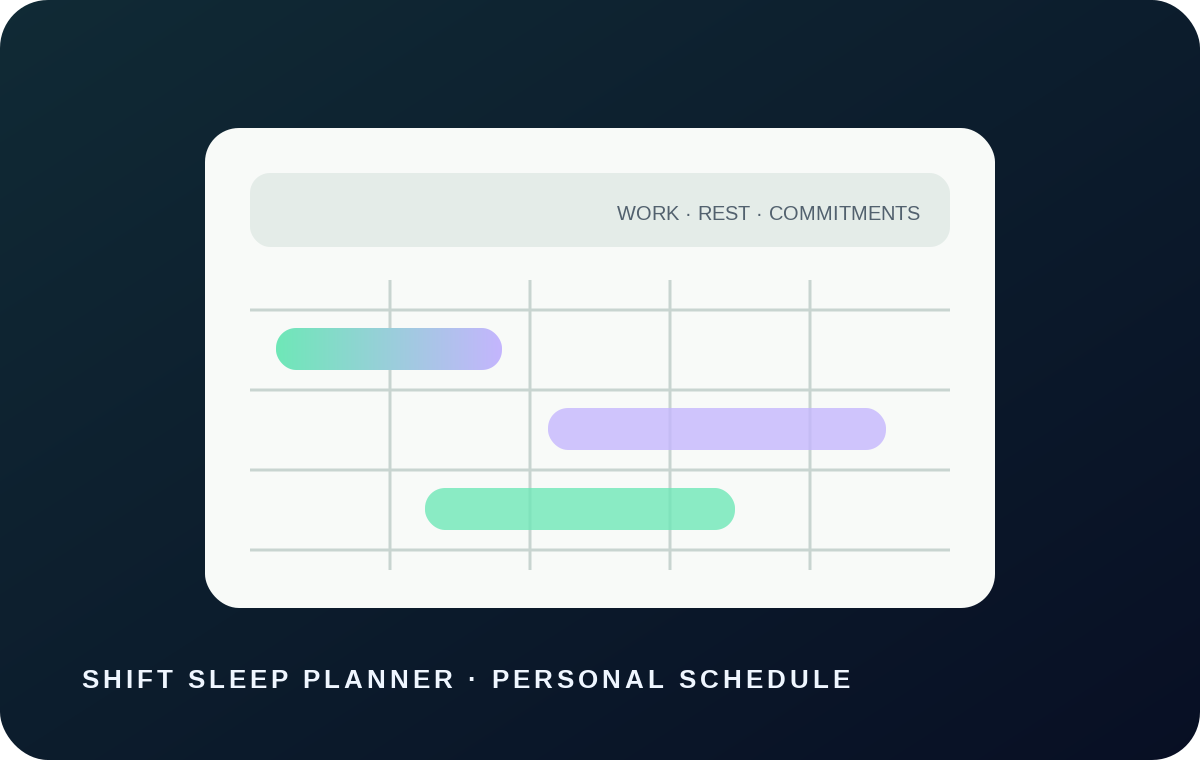
Shift Sleep Planner can display recorded work shifts alongside personal commitments and potential open-time windows. That can help a nurse see the shape of a week, but the app is not a clinical handover tool, staffing system, fatigue-risk certification, or medical service. Add only non-sensitive schedule information that you are permitted to store on your device. Do not use a suggested open window as proof that you are fit for work or safe to drive. The app does not know all factors affecting alertness, including actual sleep, workload, health, or local policy.
A practical review checklist
Before relying on any template, ask: Is this for clinical handover or personal scheduling? Has the employer approved it for that purpose? Does it distinguish confirmed from provisional duties? Does it show overnight end dates correctly? Are patient details excluded from personal notes? Can a shared calendar reveal the roster or location to people who should not see it? Is the current version easy to use during a busy handover? Have you checked local escalation and documentation rules? A “yes” to a generic template's neat layout is not enough; usability, training, and governance matter.
A nurse shift report template belongs in the clinical handover process only when it matches workplace policy. A personal shift planner should remain separate and contain minimal, non-sensitive schedule details. Research supports attention to structured communication but does not make one universal template appropriate for every unit. Shift Sleep Planner is for personal schedule context, not patient records or clinical handover.
Sources and further reading
- Müller et al. (2024), systematic review of ISBAR in nursing handover · View source
- Systematic review of structured nurse shift handover (2026) · View source
- CDC/NIOSH, Training for Nurses on Shift Work and Long Work Hours · View source