
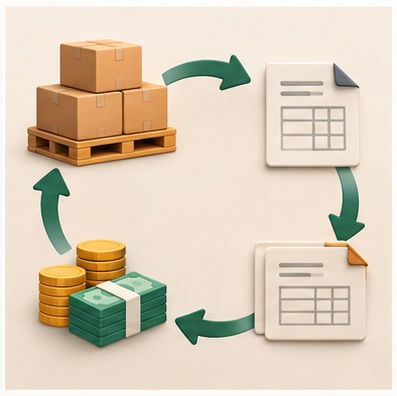
Working capital is often described as current assets minus current liabilities, but a small business owner usually meets it as a timing problem: cash leaves for stock, wages, or services before it returns from customers. A positive accounting number does not guarantee funds are available on the date a bill is due. A temporary cash dip does not by itself prove the business is unprofitable. Looking at the operating cycle connects a balance-sheet concept to purchase, delivery, invoicing, and collection steps.
Map one typical sale from start to finish. When does the business pay for materials or inventory? How long does it hold goods or complete service? When does it invoice? How long does the customer take to pay? What supplier amounts become due during that interval? This map reveals where cash is committed and which assumptions need better records. For a retailer, a slow-moving item can absorb funds before sale. For a service firm, completed work may wait on approval or a purchase-order reference before it can be invoiced.
Consider a small furniture maker. It buys materials in March, pays a contractor in April, delivers a custom order in May, and receives customer payment in June. Income may be recognized under the business’s accounting basis at a different point from cash receipt. Meanwhile, rent and payroll continue. A monthly profit report and a cash forecast therefore answer separate questions: one reviews performance, the other shows whether receipts align with obligations.
Researchers study working capital through elements such as receivable days, inventory days, payable days, and the cash-conversion cycle. A study of Spanish SMEs found associations between working-capital measures and profitability in its sample; later studies across settings report varied findings. These are relationships in particular datasets, not a universal instruction to minimize every cycle component. Extra inventory can protect against stockouts, and customer terms may support sales, while slow stock and unpaid invoices can create pressure. Context matters.
Start with a simple operating dashboard. Track customer invoices outstanding by age, inventory movement, supplier amounts due, and the timing of major receipts and payments. Compare records with actual bank and bookkeeping data. Use consistent definitions: an invoice date is not the same as a cash receipt date, and an order is not the same as delivered stock. Flag exceptions such as a disputed invoice, a customer awaiting a document, or a purchase whose delivery date moved.
Identify a practical lever that protects customer and supplier relationships. The business might invoice promptly after delivery, clarify acceptance requirements in a contract, review replenishment quantities, or contact customers before a known due date. On the supplier side, ask about agreed terms or delivery schedules rather than silently paying late. Extending customer terms, cutting stock, or delaying a supplier is not always beneficial. Each action can affect sales, supply reliability, service quality, and obligations.
Build two cash scenarios when timing is uncertain. A baseline can use expected receipt dates and known costs; a cautious case can delay selected receipts or include a likely repair. Show which assumptions changed and when available cash becomes tight. A forecast is a planning instrument, not a guarantee. JPMorgan Chase Institute research documents uneven small-business inflows and outflows and examines buffer days; that supports analyzing cash timing, not applying one reserve amount to every firm.
Review patterns over several periods. If the time between purchase and customer payment repeatedly creates a squeeze, investigate the stage: ordering, production, delivery, invoicing, disputes, or collection. Compare by product or customer segment where records allow. Avoid conclusions from one unusual month and consider seasonal demand. For accounting presentation, follow the framework and jurisdiction that apply; an internal dashboard is not a substitute for financial statements or professional advice.
Business Audit can help record and categorize business income and expenses for review, but it does not calculate a validated working-capital strategy or guarantee cash availability. Use your books, contracts, bank records, and professional advice as the basis for decisions. Learn more: Business Audit on Google Play
Official references
- García-Teruel & Martínez-Solano (2007), Effects of working capital management on SME profitability · View source
- JPMorgan Chase Institute — Cash Flows, Balances, and Buffer Days · View source
- Working Capital Management and SMEs’ Performance · View source
- U.S. Small Business Administration — Manage your business finances · View source