
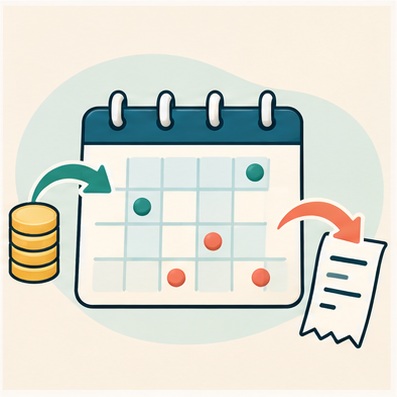
A cash calendar places expected receipts and payments on the dates money may actually move. It answers a timing question: could cash available in the account cover expected payments when they fall due? A budget usually groups income and costs over a period; the calendar makes timing visible within that period. Neither view alone guarantees that the business will have enough cash. Forecasts depend on assumptions about customer payment, supplier terms, payroll, taxes, and unexpected events.
Choose a horizon that matches the decision. A business deciding whether to make a payment next week may need a detailed near-term view, while later months can use broader estimates. Start from an opening bank balance for a stated date. Add each expected receipt and payment once, with its likely date, amount, source, and status. Keep transfers between the business’s own accounts separate from external income or spending so a consolidated view does not count the same money twice.
Use expected receipt dates rather than invoice dates. A sales invoice is not cash in the bank. Consider the due date, customer approval steps, past payment timing, disputes, and whether the invoice is disputed or partially paid. Label a receipt confirmed, probable, or uncertain and record the evidence behind that label. For payments, include payroll, rent, supplier invoices, tax remittances, debt service, subscriptions, and planned purchases. Taxes and restricted funds should be handled according to the rules that apply to the business.
Here is an illustrative example. A company opens Monday with $8,000 in available cash. It expects $6,000 from a customer by Thursday and has $9,500 of payroll and supplier payments due Friday. If the receipt arrives on time, the estimated balance after those movements is $4,500. If the customer pays two weeks late, the same calendar shows a temporary shortfall before the receipt arrives. The example is arithmetic only; actual accounting, credit terms, tax treatment, and cash availability vary.
Put uncertainty on the page rather than hiding it in a single precise date. Show a range of possible receipt dates or compare an expected case with a delayed-payment case. If several large customers are concentrated around the same date, test what happens when more than one payment shifts. A cash buffer can help, but a calendar should also prompt feasible actions: follow up on a receivable, discuss terms, adjust a discretionary purchase, or consult a lender before a problem becomes urgent. Do not count a credit line as available until its terms and access are confirmed.
Record what happened after the period closes. Compare expected dates and amounts with bank activity, explain the largest differences, and update assumptions only when the evidence supports a change. If one customer routinely pays later than its stated terms, the calendar should reflect that experience while the business reviews its collection process. If supplier invoices vary, check whether the difference came from price, quantity, freight, or timing. This feedback helps the next forecast become more useful without implying certainty.
Research on small-business cash flows points to why timing belongs in the analysis. A JPMorgan Chase Institute study used high-frequency transaction data from about one million small businesses to examine cash-flow volatility, frequency, and consistency. Its dataset and definitions describe the firms studied, not every business or country. A separate study modeling the cash flows of three self-employed workers compared forecasting methods, but a three-case sample cannot establish a universal best method. These studies support measuring timing and uncertainty; they do not prescribe a specific calendar or minimum balance.
Keep cash, profit, and working capital distinct. A profitable sale may not yet have been collected. Inventory and accounts receivable can absorb cash, while a loan repayment may use cash without appearing as an expense in the same way. Tax, accounting, and payment rules differ across jurisdictions, so a cash calendar is a planning aid, not a substitute for financial statements or professional advice. If the forecast shows recurring shortfalls, review the underlying terms, pricing, spending pattern, and financing needs rather than continually moving dates to make the balance look positive.
A practical calendar row can include date, counterparty, expected inflow or outflow, amount, status, source document, confidence note, and actual cleared date. Protect personal and bank information, limit access, and reconcile the opening and closing balances to statements. Business Audit can help organize historical income and expense records; pair those records with a forward-looking cash calendar because the app does not forecast receipts or guarantee liquidity. . Explore Business Audit on Google Play
Official references
- U.S. Small Business Administration, Manage Your Finances · View source
- JPMorgan Chase Institute, Growth, Vitality, and Cash Flows: High-Frequency Evidence from 1 Million Small Businesses · View source
- Palmer and co-authors, Cash Flow Forecasting for Self-employed Workers: Fuzzy Inference Systems or Parametric Models? (2024) · View source
- Aktas, Croci, and Petmezas, Working Capital Management, Cash Flow and SMEs’ Performance (2019) · View source