
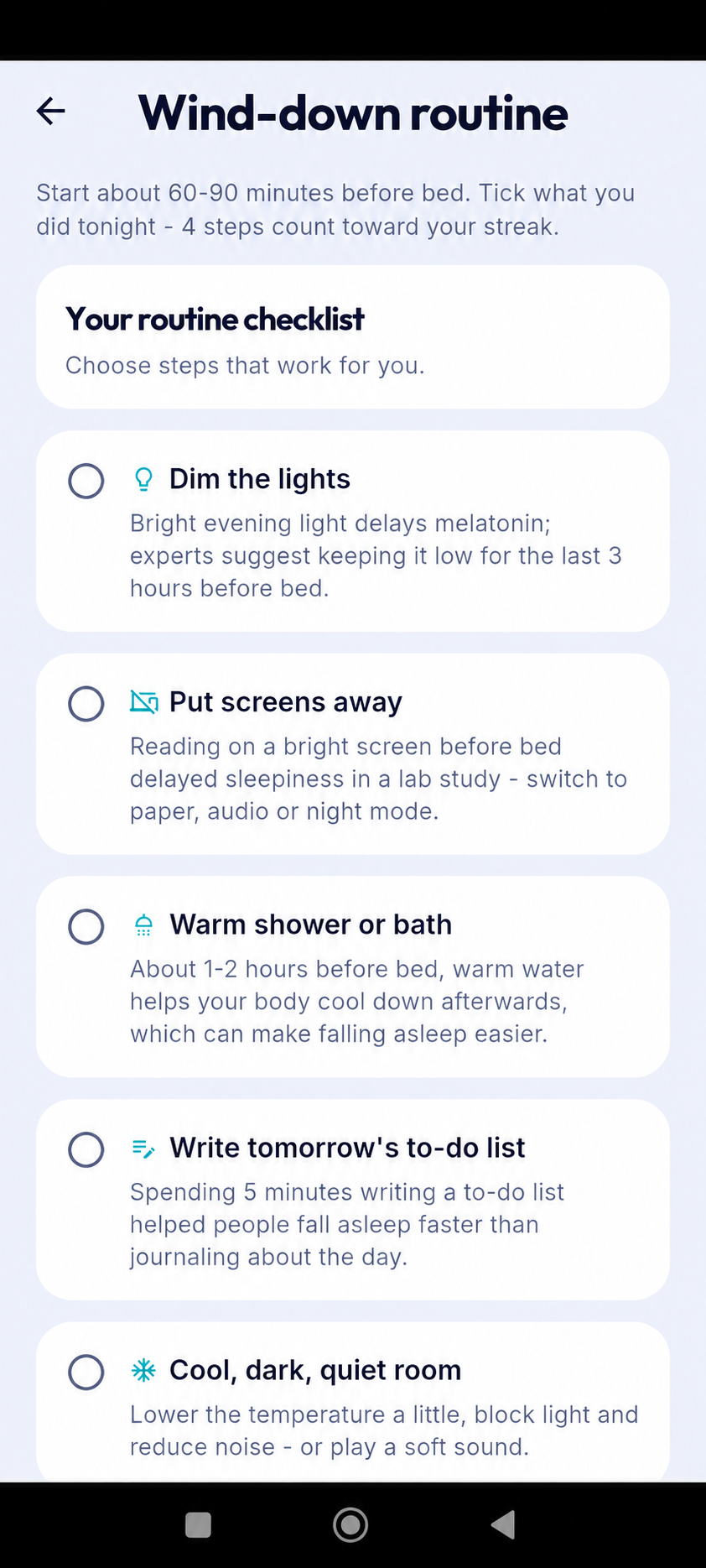
A wind-down checklist is a small sequence of choices that helps you close the day in a way that feels manageable. It is not a test you pass, and completing every item cannot guarantee that you will fall asleep. Work hours, caregiving, noise, housing, health, and personal preference all shape what is realistic. The best checklist is short enough to use on an ordinary evening and flexible enough to survive a late shift, travel, or an unexpectedly busy day.
Choose a few cues that signal the day is changing
Begin by asking what tends to make your evening feel unfinished. You might need to set out work clothes, write down tomorrow’s first task, dim a light, place a device on its charger, or spend a few minutes reading something calm. Pick two or three actions with a clear beginning and end. If a task takes twenty minutes and repeatedly feels burdensome, it may not belong on a routine intended to reduce friction.
A useful checklist describes actions, not outcomes: “put lunch container in the fridge” is controllable; “feel completely relaxed” is not. Avoid rules that imply you have failed because you are still awake. If the sequence itself becomes a source of pressure, shorten it or remove steps. The point is to create a repeatable transition, not to add another performance target to the evening.
Make the sequence work with different kinds of days
Create a standard version and a two-step fallback for late or unpredictable evenings. For example, the full version might include preparing tomorrow’s essentials, lowering household lighting where practical, and choosing a quiet activity. The fallback might be writing down one next action and setting a wake-up alarm. This makes the routine resilient without suggesting that every environment or schedule can be controlled.
If you work rotating shifts, anchor the checklist to the time you intend to sleep rather than to a fixed clock hour. Keep the steps quiet if someone else is sleeping, and do not make lighting, device, or temperature changes that are impractical or unsafe in your home. A routine can help you notice what is workable; it cannot override work demands, medical conditions, or a lack of opportunity to sleep.
What the research does—and does not—say about sleep hygiene
A 2024 bibliographic review found that studies use “sleep hygiene” to mean a varied set of behaviors, including caffeine, exercise, timing, light, noise, temperature, and wind-down routines. The authors’ review highlights that the term and its components are not applied uniformly, so it is not sound to treat a checklist as a standardized intervention with a guaranteed result.
The American Academy of Sleep Medicine guideline for adults with chronic insomnia recommends multicomponent cognitive behavioral therapy for insomnia and conditionally advises against using sleep hygiene alone as a treatment. That clinical guideline addresses people with chronic insomnia, not the value of ordinary personal routines for everyone. It is a reason to keep claims modest: a wind-down list may organize an evening, but it is not CBT-I, a diagnosis, or a substitute for appropriate care.
Review the checklist without scoring yourself
Try the same brief sequence for several ordinary evenings, then ask: Which step was easy to repeat? Which one regularly ran late? Did a shift or household responsibility make the plan unrealistic? You do not need to record a sleep score or decide whether the routine “worked” based on one night. If you keep a sleep diary, use it to describe timing and context consistently rather than to judge yourself.
Edit the list when your circumstances change. Remove steps that require equipment you do not have, add a practical task you keep forgetting, or make a separate version for days off. AuraSleep’s wind-down checklist can help you keep a simple evening routine and notes in one place. It does not measure sleep, prescribe treatment, or promise that completing the routine will prevent waking during the night.
Keep the checklist brief, controllable, and easy to adapt. Use it as an evening organizer rather than a test of sleep quality. If ongoing sleep difficulties are affecting your health or daytime function, a routine alone may not address the cause; seek guidance from a qualified health professional.
Sources
- Irish et al. (2024), Sleep hygiene—What do we mean? A bibliographic review · View source
- Edinger et al. (2021), Behavioral and Psychological Treatments for Chronic Insomnia Disorder in Adults: AASM Clinical Practice Guideline · View source