
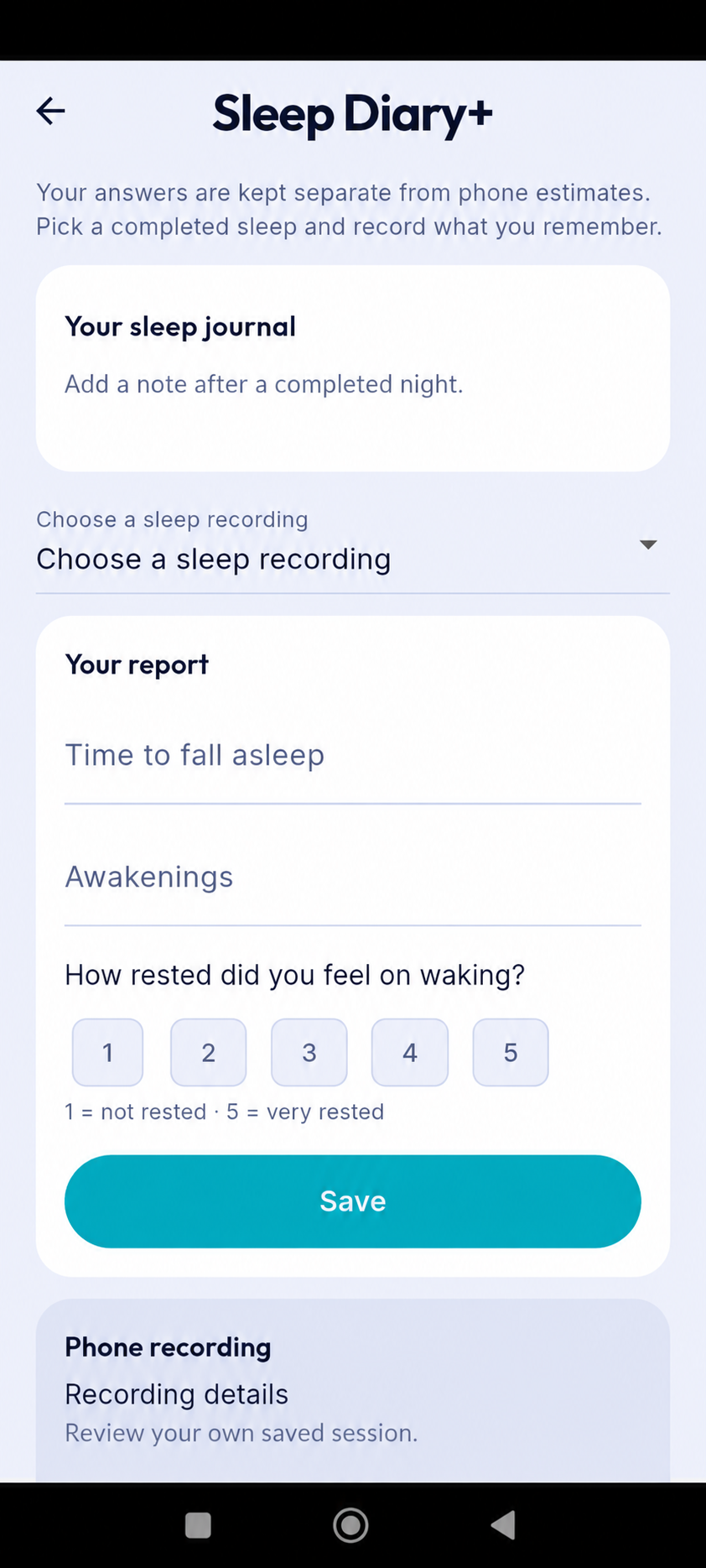
A sleep diary can make a night easier to remember, but “how long I slept” is not always a number you can observe directly. Time in bed, the time you tried to sleep, remembered wake periods, and a device’s estimate describe different things. A useful record names which one you are writing down and makes uncertainty visible. The goal is a consistent account you can compare with your own routine—not a precise measurement or a verdict on whether the night was successful.
Separate the timeline before calculating a duration
Write down the parts of the night in plain language: when you got into bed, when you tried to sleep, your best estimate of when sleep began, any remembered longer waking, your final awakening, and when you left bed. The interval from getting into bed to getting out is time in bed; it is not automatically time asleep. If you do not remember the exact onset or every awakening, leave the entry approximate instead of filling gaps with false precision.
This distinction is particularly useful when schedules shift. A person who finishes work after midnight may spend time winding down before attempting sleep, while someone else may wake early and remain in bed. Recording the event you actually remember helps future readers understand what the number means. Avoid subtracting every brief movement or moment of uncertainty unless your chosen diary method asks for it; changing the method from night to night makes comparisons harder.
Choose one repeatable method and keep estimates honest
Use the same prompts each morning, at a time when recalling the night is reasonably convenient. The Consensus Sleep Diary was created to standardize self-reported sleep information for research and clinical contexts. Borrowing its emphasis on consistent questions can make a personal log easier to review, but copying a form does not turn an app into a clinical assessment. Record “about 6½ hours” if that is all you remember, and label device-generated estimates separately from your recollection.
A community study comparing a Consensus Sleep Diary with actigraphy and single-channel EEG found that the methods did not agree perfectly. The diary was more closely aligned for some timing measures, while average total sleep time differed from the device and EEG estimates in that study. Those results do not mean a diary is useless or that any sensor is ground truth; they show that tools measure or infer sleep in different ways. Population, device, diary prompts, and study setting matter.
Read duration alongside the question you are asking
If your question is whether a new work rota changed the time available for rest, start with bedtime and wake-time boundaries. If you want to describe remembered sleep, keep the estimate distinct. If the question is how you felt during the day, note that separately rather than assuming duration answers it. A short note about an alarm, caregiving interruption, travel, or illness may explain why a night looks unusual without claiming that the event caused the change.
Do not use one unusually short or long entry to create a new personal target. Adult sleep-duration recommendations are population guidance and cannot account for every age, health situation, schedule, or individual need. If you track duration, look at multiple entries and preserve the number of nights included. A month with only a few recorded sessions does not describe every night of that month, and a weekly average can conceal a workday/free-day pattern.
Keep the record helpful and proportionate
A few entries are often easier to maintain than a log filled with dozens of fields. Choose details that support a real question, review them after several days, and stop collecting fields that do not help you make sense of your routine. If you share a record with a clinician, explain whether the figures are recalled estimates or sensor outputs; the context helps them interpret what the data can and cannot say.
AuraSleep’s diary can organize a morning reflection separately from its phone-based estimates. Use that distinction to keep memory and inference visible. The app does not measure brain activity, confirm exact sleep duration, diagnose a condition, or decide whether your sleep is adequate. If sleep difficulty persists, daytime functioning is affected, or you are concerned about a symptom, discuss it with a qualified health professional.
A sleep-duration entry becomes more useful when you identify what it represents, use the same prompts, and keep estimates separate from sensor outputs. Compare several nights in context, preserve the number of observations, and use the diary as a record—not as a diagnosis or score.
Sources
- Carney et al. (2012), The Consensus Sleep Diary: Standardizing Prospective Sleep Self-Monitoring · View source
- Dietch & Taylor (2021), Evaluation of the Consensus Sleep Diary in a community sample · View source