
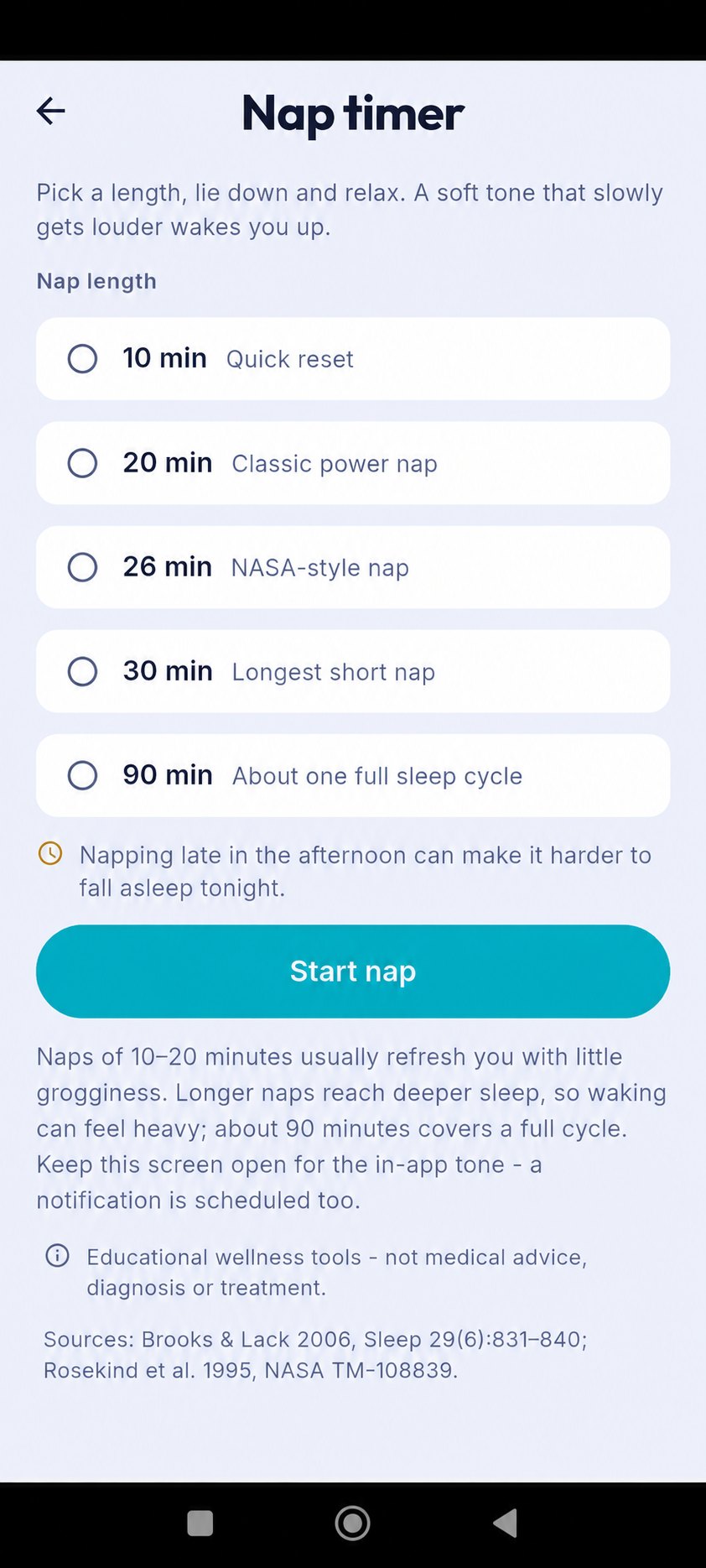
A nap timer can help mark when a planned rest opportunity begins and ends, but the timer does not know how quickly you will fall asleep or how alert you will feel afterward. That distinction matters when a nap sits close to a commute, a shift, or caregiving. Instead of treating a single duration as a universal prescription, plan the whole window: when you can lie down, how much time is available, when the alarm will sound, and what must happen before your next task.
Start with the next obligation and work backward
First note when you must leave home, report to work, or resume another responsibility. Reserve time to wake, orient yourself, use the bathroom, drink water if you normally do, and get ready. The nap opportunity is only part of the interval. If you need to travel or perform a safety-sensitive task, do not schedule the alarm to ring at the moment you need to begin that task.
Then decide how much time is actually available for quiet rest. If sleep does not come quickly, the timer still marks the end of the opportunity, not the amount of sleep you obtained. A phone or wearable estimate should not be mistaken for a confirmed sleep duration. Avoid adding late naps automatically if they regularly make your main sleep period harder; track the pattern and adapt to your own schedule.
Why nap length and timing do not have one simple answer
Studies examine different nap opportunities, work schedules, levels of prior sleep, and outcomes. A simulated night-work experiment compared several nap lengths and found that post-nap sleep inertia and later performance changed over time; the result depends on when the nap occurred and what measure was tested. Those laboratory findings are useful for understanding trade-offs, not a promise that a specific number of minutes will work the same way in a different job or for every person.
The 2026 American Academy of Sleep Medicine guideline conditionally suggests a nap before a night shift for adults with shift work disorder and excessive sleepiness. The recommendation is based on limited, low-certainty evidence, and the guideline warns that sleep inertia after waking may temporarily raise sleepiness and risk. Its clinical recommendation concerns a defined population; it is not a general instruction that every shift worker should nap or that a nap replaces a sufficient main sleep opportunity.
Build a realistic timer rather than chasing a perfect cycle
Set the timer for the time you can actually spare, then include the wake-up buffer outside that duration. Do not assume that a consumer “90-minute cycle” calculation can predict your sleep stages or ensure an easy awakening. Sleep cycles vary, a nap may begin later than planned, and personal sleep debt and circadian timing influence how waking feels. A timer can help you remember the boundary you chose, but it cannot sense whether the plan is appropriate for your health or work duties.
If a quiet room or protected break is unavailable, note that as a constraint instead of blaming yourself for not following an ideal plan. For an on-duty nap, follow employer rules and local safety procedures. Never use a timer setting as clearance to drive, operate equipment, or return to a task while you remain markedly sleepy. Ask a clinician about repeated sleepiness or persistent sleep problems.
Use a short review to improve the next plan
After the nap, record only a few practical details: planned window, whether you fell asleep, how you felt immediately on waking, and how long it took before you felt ready for the next activity. Keep the observation separate from conclusions such as “this duration is always best.” A few entries across comparable days can show whether your timing is workable; a single nap cannot establish a personal rule.
Change one planning detail at a time when possible: move the opportunity earlier, allow a longer transition, reduce interruptions, or avoid placing the nap close to a main sleep period if you notice that pattern. Do not keep increasing nap length to compensate for chronic lack of sleep. AuraSleep can help you organize a sleep target and notes around your schedule, but the timer is a planning aid, not a sleep measurement, fatigue detector, or clinical recommendation.
Plan the whole rest window, including time after the alarm before you travel or resume demanding work. Research supports caution about post-nap sleep inertia and does not identify one ideal duration for every person. Use a timer to keep track of a personal plan, then review how that plan fits your real schedule.
Sources
- American Academy of Sleep Medicine (2026), Management of shift work disorder: Clinical Practice Guideline · View source
- Hilditch et al. (2012), Duration of sleep inertia after napping during simulated night work and in extended operations · View source