
A nap can be part of someone's day, but its effect depends on the person, timing, prior sleep, work demands, and what happens after waking. No single nap length guarantees that a person will feel alert or be ready for safety-sensitive tasks. This guide focuses on planning and recording a nap opportunity, allowing time for the next obligation, and describing limits accurately. It is not a recommendation to nap in place of adequate sleep or a test of fitness for work.
Start with the next obligation
Before planning a nap, note the next fixed event: a shift, a commute, caregiving, or an appointment. Include travel and preparation time if they apply. A calendar gap can look generous while leaving little transition time. Record the nap as an intended opportunity, and add a separate wake-up buffer that fits your circumstances. Do not interpret this block as proof that sleep occurred.
If you must drive, operate equipment, provide care, or perform another safety-sensitive task, do not use an app or a timer to decide that you are safe. Follow workplace procedures and applicable guidance. A nap plan cannot assess alertness or remove risks from fatigue.
Why the transition after a nap matters
Some people experience sleep inertia—a period of grogginess or reduced performance after waking. A review of short naps discussed how findings vary with prior sleep, time of day, and other conditions; short duration alone does not guarantee no inertia. Use this evidence to avoid promising a precise outcome. If you record how you felt, write it as a personal observation rather than a universal rule.
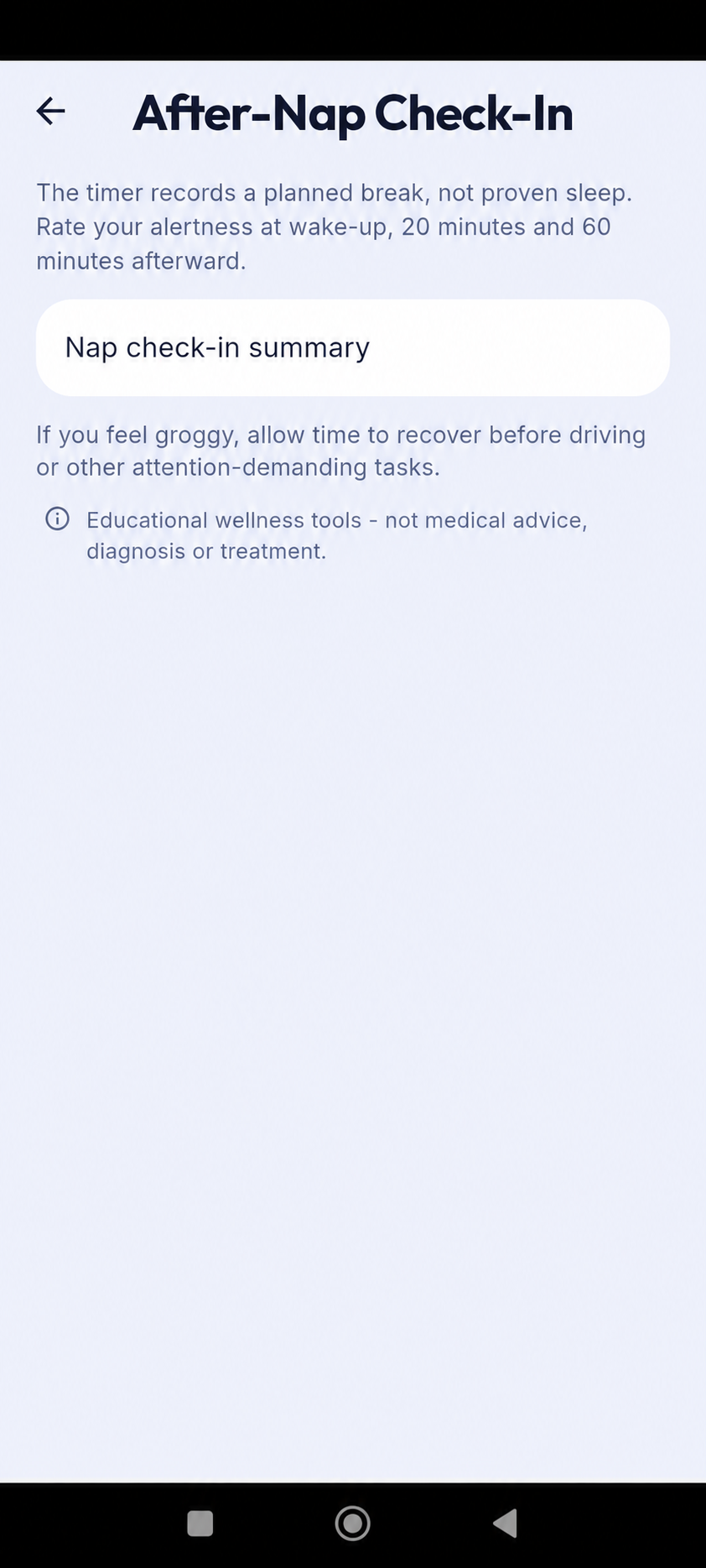
A practical note might include the planned start, approximate wake time, any interruption, how you felt after getting up, and the time of the next task. If the nap did not happen, record that too. These details help explain the day without turning the entry into a score or medical conclusion.
Keep naps in context with the main sleep opportunity
A nap does not automatically compensate for repeatedly curtailed or disrupted sleep. NIOSH materials discuss strategic napping as one possible fatigue-management measure in some work contexts, alongside the limits of shift work and the importance of sleep. Workplace policy, local rules, role, and individual circumstances matter. Do not rely on an informal nap plan as a substitute for required rest or staffing safeguards.
If you are working shifts, compare the nap opportunity with the full sequence: duty end, travel, home responsibilities, intended main sleep, and next start. Note roster changes that altered the plan. A calendar helps reveal timing; it does not know whether you slept, how restorative it was, or whether you are fit for work.
Review your notes without overinterpreting
After several entries, look for practical patterns such as a repeated conflict with a commute or an appointment scheduled too soon after waking. One entry may be unusual. Use a clear distinction between planned and actual events, and describe the context: night duty, a noisy room, illness, or a missed alarm. These notes can support a conversation with an employer or clinician, but they cannot establish causation.
If persistent sleepiness, unusual events, or difficulty sleeping concerns you, speak with a qualified health professional. Do not use a nap tracker to diagnose a disorder or change treatment. If there is an immediate safety risk, follow local safety procedures.
AuraSleep as a personal journal
AuraSleep can help you write and review personal sleep notes. The app does not prescribe nap timing, measure alertness, or promise a recovery benefit. Keep recordings private, especially in shared spaces, and review app permissions and deletion controls. Treat every displayed time block as a planning note rather than a clinical measure.
Plan around the next real obligation, leave a transition that makes sense for you, and keep the record descriptive. Napping is not a guarantee of alertness or a replacement for appropriate sleep and workplace safeguards. AuraSleep organizes observations without making those decisions.
Sources
- NIOSH/CDC — Napping at Work · View source
- Hilditch & McHill (2019), A review of short naps and sleep inertia · View source
- NIOSH/CDC — Fatigue and Shift Work · View source