
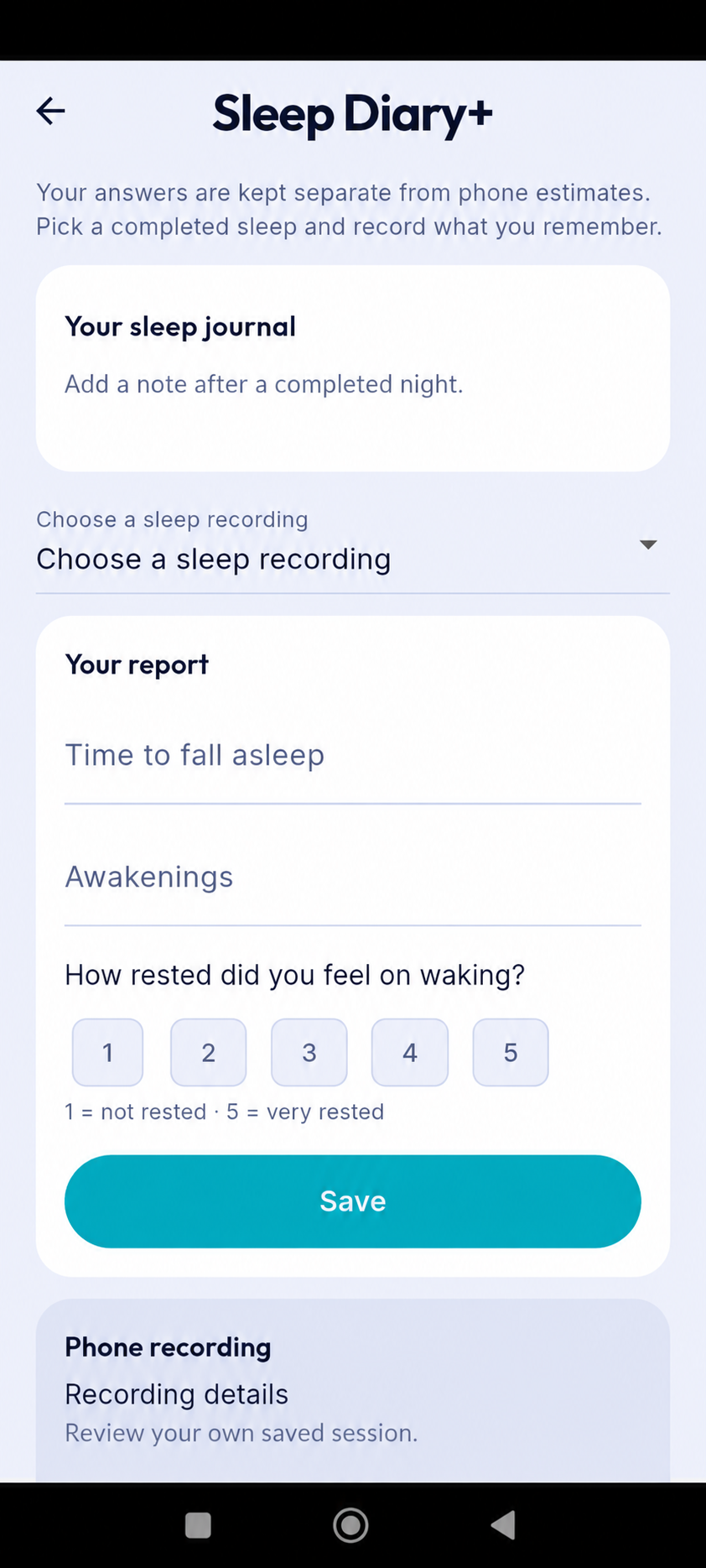
A morning sleep review is a brief check of what you recorded, not a verdict on whether the night was good or bad. Sleep is difficult to reconstruct perfectly after waking, and a phone or wearable may estimate a different boundary from the one you remember. A useful routine keeps the original observations visible, separates estimates from measurements, and avoids letting one score define the whole night. The aim is to make a record you can understand later, not to inspect every minute or diagnose a problem.
Start with the timeline, not a score
Record a few stable points in the order they happened: when you got into bed, when you tried to sleep, your best estimate of when sleep began, the final time you woke, and when you left bed. These are different events. Getting into bed is not the same as falling asleep, and waking is not always the same as getting up. If you do not remember an exact minute, use a reasonable estimate or leave the field blank rather than inventing precision.
A brief note can add context that a clock cannot provide. You might write that an alarm woke you early, a child needed care, a late shift ended after midnight, or a noisy delivery interrupted the morning. Keep the wording descriptive: “woke twice after a late shift” is an observation; “the shift caused poor sleep” is a causal conclusion that the note alone cannot establish.
Ask one question that will still matter next week
Choose one useful question for the morning, such as whether your bedtime moved later than intended, whether you remember a long awake period, or whether something unusual affected the routine. Answer only what you can reasonably recall. A short, repeatable question is easier to compare across days than a long checklist that changes whenever a night feels disappointing.
The Consensus Sleep Diary was developed to standardize prospective self-monitoring in research and clinical contexts. Its contribution is a shared way to ask about sleep-related times and experiences, not a promise that every person can recall them perfectly. You can borrow the principle of consistent questions without treating a consumer app entry as a clinical instrument or trying to calculate every sleep measure yourself.
Keep diary notes and sensor estimates in separate columns of your mind
A diary captures your recollection and experience. A phone sensor or wearable infers sleep-related periods from signals such as movement, light, or sound, depending on the device. Those sources answer related but different questions. If they disagree, preserve both readings and note the difference instead of deciding that one must be the truth.
A 2025 longitudinal study compared smartphone sensor estimates with sleep diaries and actigraphy in a small sample of healthy college students. The group-level findings showed reasonable alignment for some timing measures, but estimates still differed and the authors called for larger, more diverse samples. That study does not validate every app, device, age group, or sleep feature. It is a reason to interpret personal records as complementary observations rather than interchangeable measurements.
Make the review small enough to repeat
Give the review a natural stopping point: confirm the date, add one sentence about an unusual event, and save the entry. You do not need to reread every clip or calculate a score each morning. If you work rotating hours, include the shift and the local date so a daytime sleep period is not mistaken for a missing night. A record that fits your real routine is more useful than an idealized template you abandon.
AuraSleep can help keep sleep recordings, notes, and overviews together for later reflection. Use those records to describe patterns or prepare a question for a professional; the app does not measure every stage of sleep, prove the cause of a symptom, or diagnose a disorder. If sleep difficulty is persistent, distressing, or affecting daily function, a qualified healthcare professional can interpret the wider picture.
Keep the morning review brief and consistent: record what you remember, label estimates honestly, and add context when the night was unusual. Compare patterns across time without turning a single entry or app score into a diagnosis. AuraSleep can organize personal observations, while clinical questions belong with a qualified professional.
Sources
- Carney et al. (2012), The Consensus Sleep Diary: Standardizing Prospective Sleep Self-Monitoring · View source
- Kirshenbaum et al. (2025), Comparison of Sleep Features Across Smartphone Sensors, Actigraphy, and Diaries Among Young Adults · View source