
A late-afternoon nap can feel like a practical reset after a short night, a demanding shift, or an unexpectedly long day. It can also make it harder for some people to feel sleepy at their usual bedtime. Both experiences are plausible: a nap reduces some of the pressure to sleep that has built during waking hours, while the amount of that pressure and the timing of the nap vary from person to person. The useful question is not whether every nap is good or bad. It is what happens to alertness, bedtime, and the next night in your own circumstances. Research on daytime naps finds potential short-term cognitive benefits, but studies differ in participants, nap timing, duration, and outcome measures. This guide treats naps as a planning choice, not a treatment or a promise of better sleep.
What nap studies can—and cannot—tell you
Reviews of daytime nap research report that naps may improve some measures of alertness or cognitive performance, particularly when people are sleepy. Findings are not uniform, and a short period of grogginess after waking—often called sleep inertia—can occur. A systematic review and meta-analysis of short naps found benefits on some outcomes while noting variation in methods and uncertainty about immediate post-nap effects. An earlier review focused on sleep inertia likewise describes differences by sleep stage, prior sleep loss, nap timing, and the task used to measure performance. These are group-level findings; they cannot predict exactly how one late nap will affect one person's bedtime. Much of the research evaluates a limited window after a nap rather than the full sequence of nap, evening sleep, and next-day functioning.
Use published findings as context. Your own repeatable observations and any advice from a clinician who knows your health situation are more relevant to an individual decision.
Why a late nap may shift bedtime
Sleep pressure generally grows during time awake and eases during sleep. A nap late in the day can therefore reduce the feeling of sleepiness available at a usual bedtime for some people, especially when the nap is long or ends close to bedtime. The size of that effect is not fixed: prior sleep, regular schedule, light exposure, caffeine, medication, and individual differences all matter. A nap may also be needed after an unusually short night, so simply avoiding every nap is not a universally helpful rule. Occupational guidance from NIOSH discusses planned naps as one fatigue-management option for workers, while also emphasizing that naps do not replace adequate recovery sleep. That work-safety context should not be mistaken for a prescription for everyone or for evidence that a nap can compensate for chronic sleep restriction.
If you have an early start, a rotating shift, or a persistent sleep problem, consider the whole schedule rather than changing nap duration in isolation.
Run a small, low-risk personal observation
For a week or two, note the nap start and end time, approximate duration, prior night's sleep opportunity, caffeine timing, and the time you went to bed. The next morning, record a simple observation such as “fell asleep easily,” “took longer than usual,” or “schedule was disrupted.” Avoid turning a few entries into a clinical score. Compare like with like: a workday after a night shift is not a fair comparison with a quiet day off. Change one factor at a time if your routine allows—for example, move the nap earlier while keeping other habits reasonably similar. A sleep diary is more useful when it captures uncertainty and exceptions than when it pretends to measure sleep precisely. If tracking makes you anxious or preoccupied, stop and choose a simpler approach.
Do not intentionally deprive yourself of sleep to create a comparison. If you must drive or perform safety-sensitive work while very sleepy, prioritize immediate safety and appropriate workplace procedures.
Choose timing around the real constraint
When a late nap repeatedly seems to delay bedtime and nighttime sleep is your priority, an earlier opportunity or a shorter planned rest may be worth trying if feasible. People who work nights or rotating schedules may need daytime sleep and a different nap window; ordinary clock-time advice may not fit them. Keep enough time after waking to notice how alert you feel before driving or doing hazardous tasks, because sleep inertia can briefly affect performance. If you are taking a nap because sleepiness is overwhelming, that is useful information rather than a personal failure. Look for the underlying constraint—short sleep opportunity, caregiving, illness, shift timing, medication effects, or another factor—and seek qualified guidance when the problem persists.
There is no single nap length or cut-off time established by these sources as ideal for every adult. Treat practical adjustments as experiments, not rules.
Use AuraSleep as a notebook, not a sleep test
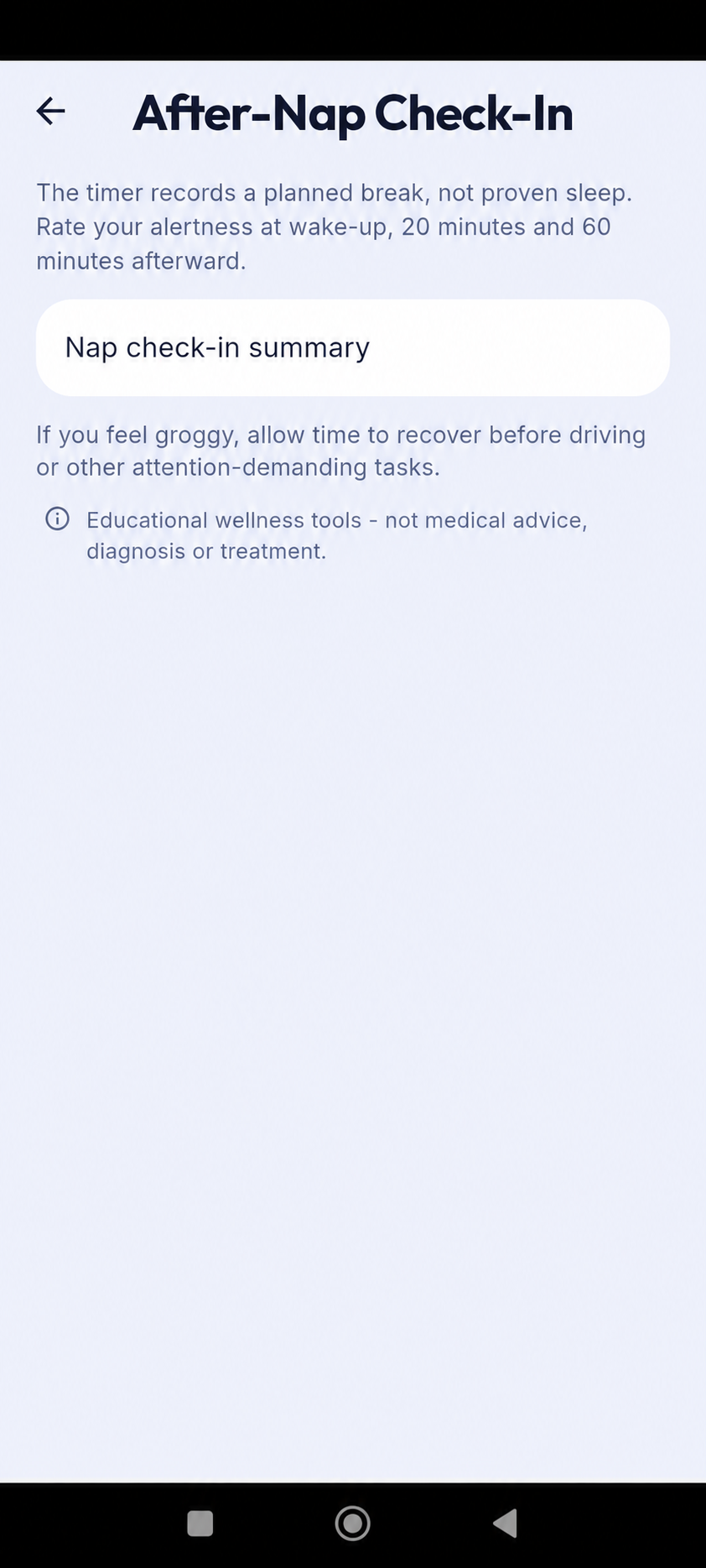
AuraSleep can help organize sleep-session notes and routines so you can review patterns over time. A record can make it easier to remember when a nap occurred and what your evening looked like; it cannot establish why you felt sleepy, measure sleep stages reliably from a note alone, or diagnose a sleep disorder. Keep entries brief and interpret them cautiously. One late bedtime after a nap does not prove causation, and a smooth bedtime does not prove that a nap is beneficial in every context. The app is a personal organization tool, not medical advice or treatment.
If you regularly struggle to stay awake despite a reasonable sleep opportunity, experience sleepiness that affects safety, or have symptoms that concern you, talk with a healthcare professional. Bring a concise diary if it helps describe the pattern.
Late-afternoon naps may help some people feel more alert and may delay bedtime for others. Evidence supports neither a universal ban nor a universal prescription. Observe the timing and your circumstances, make one comfortable adjustment when useful, and seek personalized advice for persistent or safety-relevant sleepiness. AuraSleep can organize personal notes, but it does not measure or diagnose sleep.
Sources
- Dutheil et al. (2021), systematic review and meta-analysis of short daytime naps · View source
- Hilditch and McHill (2019), sleep inertia review · View source
- CDC/NIOSH, Napping at Work · View source