
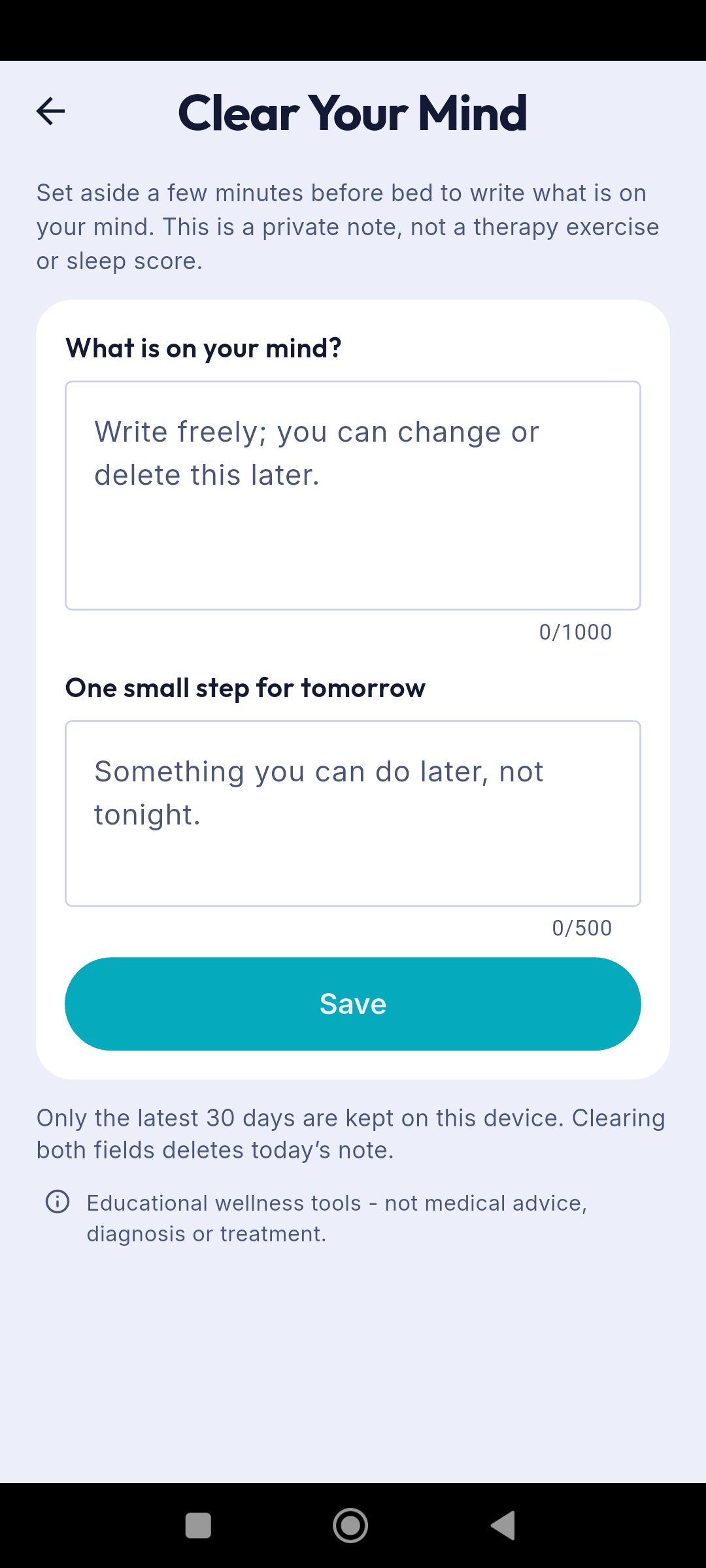
When unfinished tasks keep returning to mind, trying harder not to think about them can become another task. A short writing exercise offers a different option: capture the thought, name one next step if there is one, and leave the page until tomorrow. This is a practical reflection routine, not a way to solve every concern or force sleep. Its value is that the note can hold a reminder outside your head while you return to a calmer evening.
Write down what is competing for attention
Set a small limit, such as a few minutes or a short list. Write the task or concern in plain language, then add one next action only if it is clear: “send the invoice after breakfast,” or “ask about the appointment time.” Separate something you can act on tomorrow from a worry that has no immediate action. The exercise is about capturing, not completing, the list.
Keep the note concrete and finite. A phrase like “everything at work” may invite more rumination; a specific reminder such as “check the revised schedule” gives the future task a place to wait. If writing expands into planning the entire week, pause and choose one next step. The aim is to close the notebook, not to turn bedtime into an administrative session.
What a bedtime-writing study found—and what it did not
In a 2018 sleep-laboratory experiment, 57 healthy young adults were assigned to write for five minutes either about tasks they needed to complete in the coming days or about tasks they had already completed. Participants in the future-task list group fell asleep faster on that study night than participants in the completed-activities group. Within the task-list group, more specific lists were associated with faster sleep onset.
The study was a controlled experiment, but its limits matter: a relatively small group of healthy adults aged 18–30, a single laboratory night, and a comparison between two writing prompts. It did not test AuraSleep, establish a long-term effect, include every age or health condition, or prove that the exercise treats insomnia. Use the result as a reason to consider a brief experiment with your own routine, not as a promise of a certain number of minutes saved.
Keep the exercise separate from sleep tracking
Writing a future task is different from reviewing last night’s sleep. One helps park a thought; the other records a past experience. Combining them into a long session can make a simple routine feel like work. If tracking tends to make you monitor the clock or worry about a score, write the practical task on paper and postpone reviewing sleep data until another time.
A consistent diary can be useful for prospective self-monitoring, but a diary is not a requirement for every bedtime and it does not reveal the cause of a difficult night. Carney and colleagues developed a consensus format to standardize diary questions used in research and clinical settings. That work supports clear, consistent records; it does not suggest that people should repeatedly check their sleep or evaluate each evening before bed.
Build a gentle stopping point
Choose a predictable closing action after writing: put the list away, set the first task for tomorrow, and return to a low-demand activity that fits your preferences. If a concern needs support, mark whom you could contact rather than trying to settle it at night. Do not use the exercise to defer urgent safety, medical, or practical needs.
AuraSleep’s Clear Your Mind tool can help capture a thought and one next step, so the note is available without turning it into a sleep score. The app cannot make a worry disappear or treat anxiety or insomnia. If distress, racing thoughts, or sleep difficulty keeps returning and affects daily life, consider speaking with a qualified healthcare professional.
Try a short, specific list if unfinished tasks are keeping your attention. Put it away when the time is up and see whether the routine feels useful over several evenings. The small laboratory study is encouraging but limited; bedtime writing is an optional personal exercise, not a guaranteed sleep aid or treatment.
Sources
- Scullin et al. (2018), The effects of bedtime writing on difficulty falling asleep: A polysomnographic study comparing to-do lists and completed activity lists · View source
- Carney et al. (2012), The Consensus Sleep Diary: Standardizing Prospective Sleep Self-Monitoring · View source